
- Buy Crypto
- Markets
- Futures
- Spot
- Copy Trade
 Earn
Earn- More
Not even MicroStrategy is buying the dip on BTC anymore. How's your DAT stock holding up?

Original Article Title: "Even MicroStrategy Has No More Ammunition to Buy the Dip in BTC, How Is Your DAT Stock Doing?"
Original Article Author: David, TechFlow at DeepTide
Over the past month, BTC has dropped from its all-time high of $126,000 to below $90,000, with a 25% pullback plunging the market into panic, and the fear index has reached single digits.
But that man, he continues to buy.
On November 17, Michael Saylor, as usual, posted a tweet on Twitter: "Big Week."
Subsequently, the announcement showed that MSTR bought another 8,178 BTC, spending $8.356 billion, with a total BTC holding exceeding 649,000.
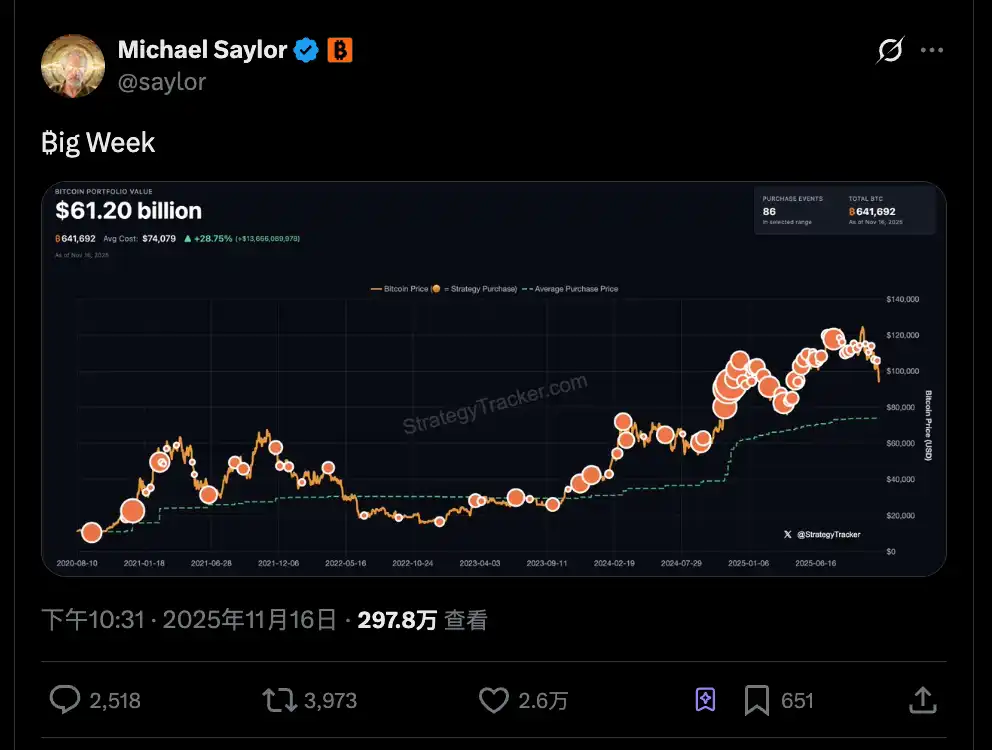
Don't panic, the biggest bull is still there. But is that really the case?
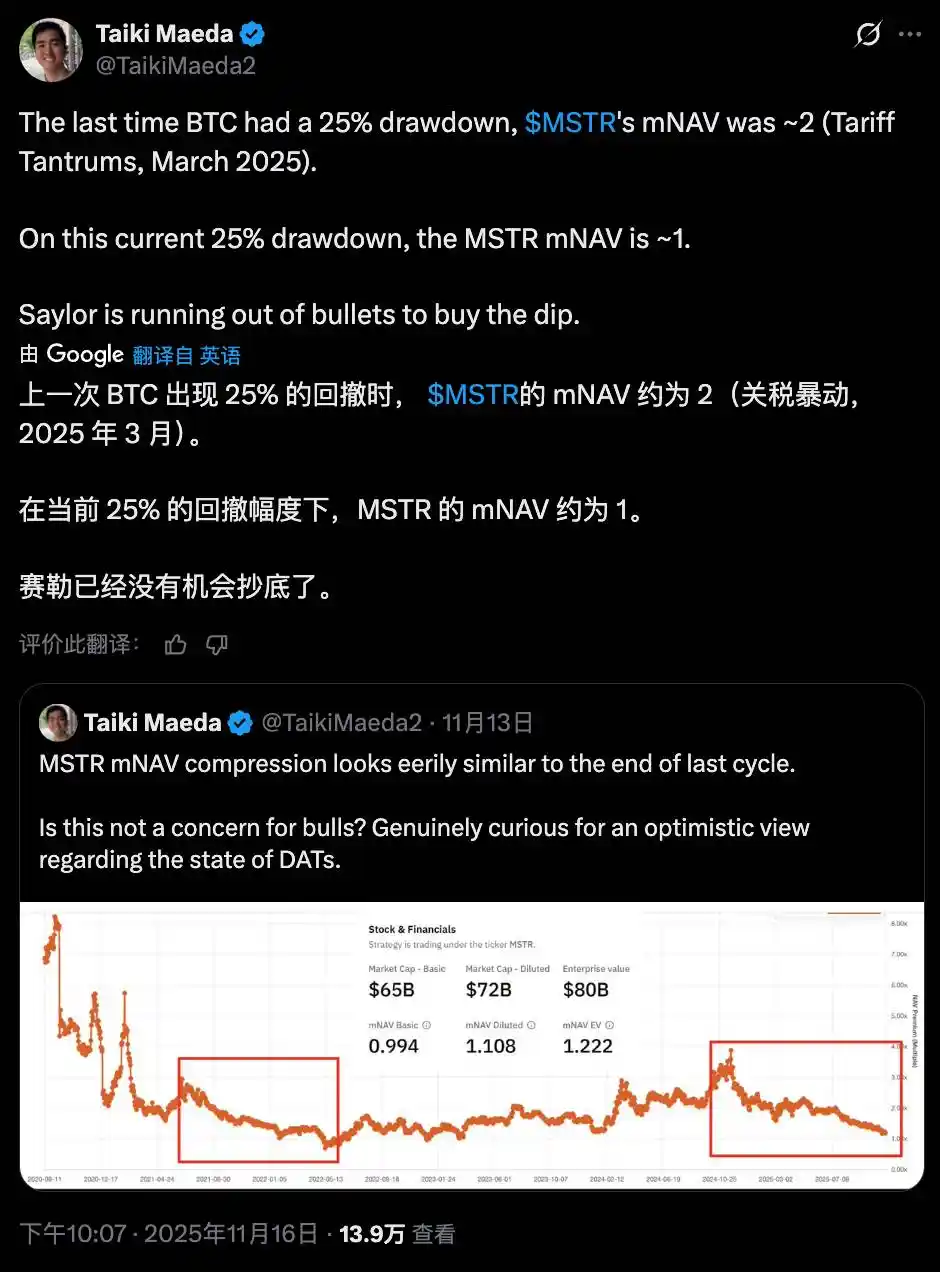
Although the comments section on Saylor's post was full of excitement, someone pointed out a key piece of data:
MSTR's mNAV is about to drop below 1.
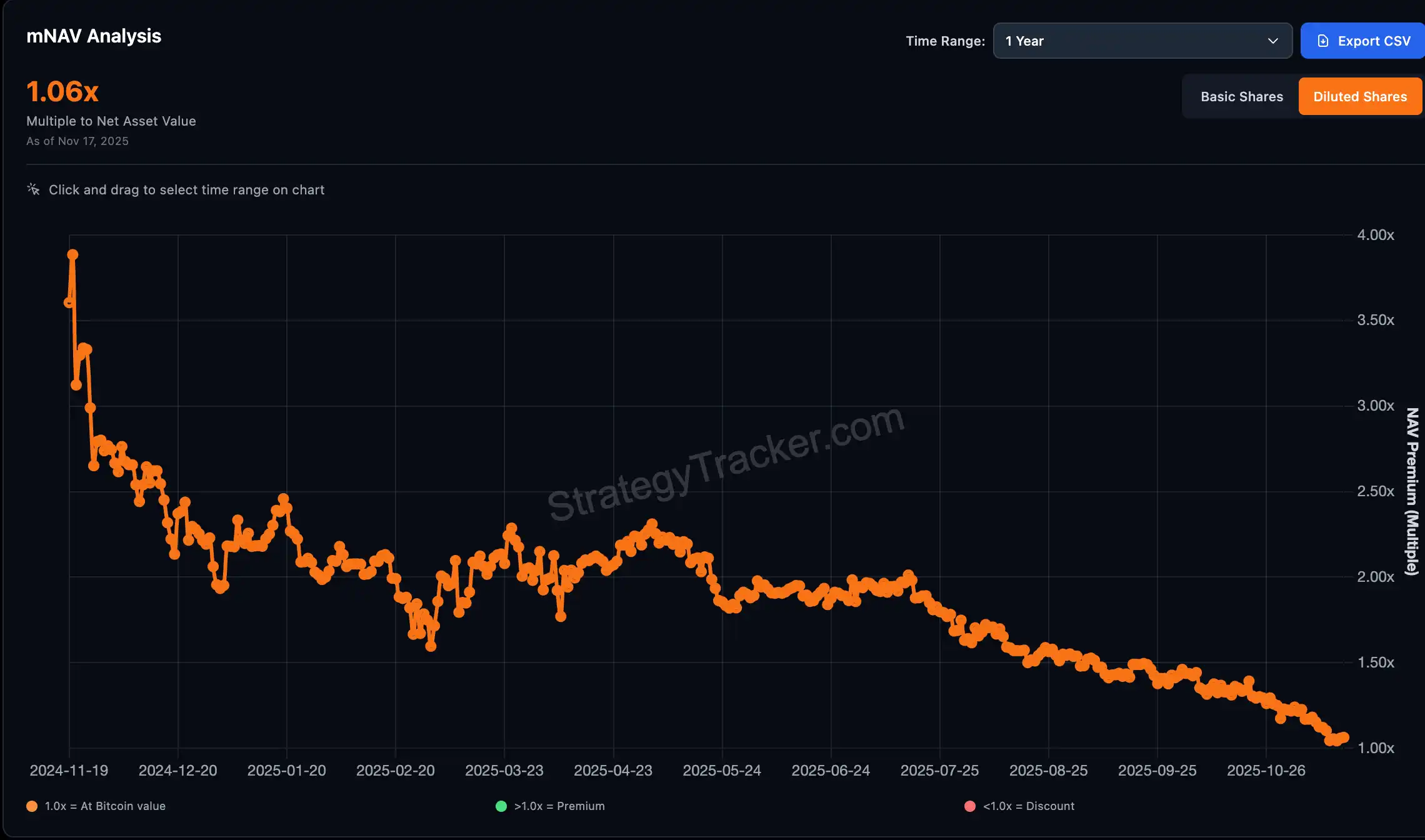
mNAV, Market Net Asset Value multiple, is a key indicator that measures MSTR's stock price relative to its BTC asset premium.
In simple terms, mNAV=2 means the market is willing to pay $2 for $1 worth of BTC assets; mNAV=1 means the premium disappears; mNAV<1 means a discount trading.
This indicator is crucial to Saylor's entire business model.
For comparison, when was the last time BTC dropped by 25%? The answer is in March of this year.
At that time, Trump announced tariffs on multiple countries, and the market wailed, with the Nasdaq plummeting by 3% in a single day, dragging the crypto market down with it.
BTC dropped from $105k all the way to $78k, a drop of over 25%. But at that time, MSTR's status was completely different.
The mNAV was still hovering around 2, and Saylor had a whole set of financing tools in hand: convertible bonds, preferred shares, ATM issuance... ready to come up with money at any time to buy the dip.
What about this time? mNAV has dropped below 1.
This means that the path of issuing stock to buy coins is gradually becoming unfeasible. For example, if you issue $1 of stock now, investors may only be able to buy BTC worth $0.97, which is not bottom fishing but rather paying a premium.
And according to MSTR's Q3 financial report, the company's cash on hand is now only $54.3M.
In other words, it's not that Saylor doesn't want to buy heavily anymore, it's that he may really be unable to buy anymore.
November Last Year vs. November This Year
Don't believe Saylor can't buy anymore? Maybe look at last year's balance sheet.
November 2024, Trump was elected, and BTC skyrocketed from $75k to $96k.
What was Saylor doing? Buying heavily.
Where did the money come from? Issuing debt. A $3 billion convertible bond, maturing in 2029, with the key point being no interest payment required.
A year later today, the situation has changed dramatically.
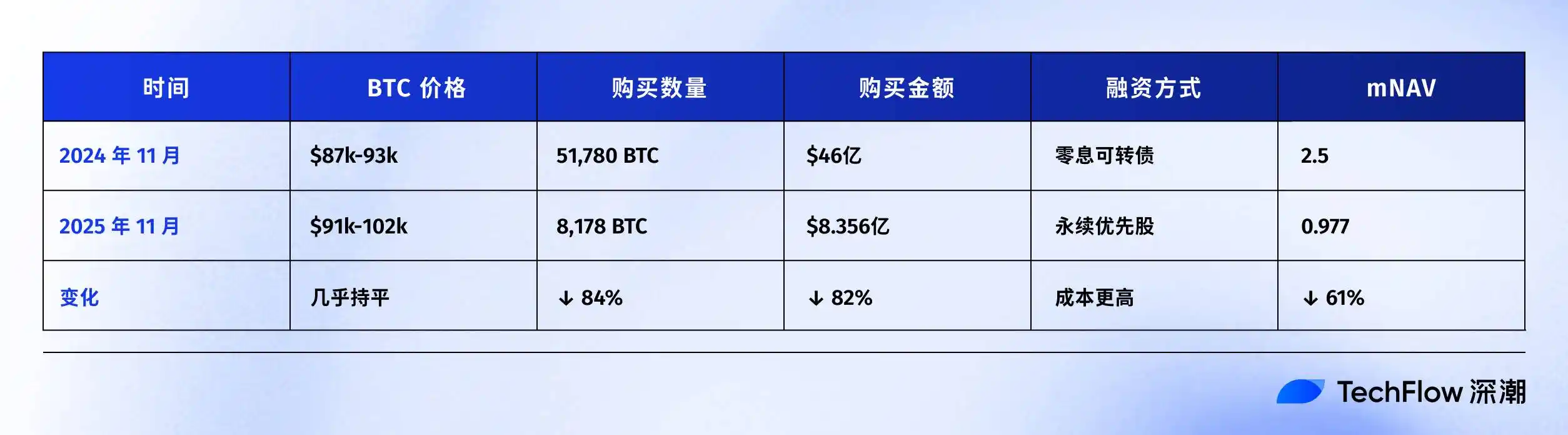
Aside from the price changes, the shift in financing method is also worth noting.
Last year, Saylor borrowed $30 billion to buy BTC, without the need to pay interest, simply returning the money in 2029. Essentially, it was free money.
This year, Saylor can only sell a specific type of stock (perpetual preferred stock), requiring 9-10% of the money to be taken out of MSTR's account each year and distributed to those who own these stocks.
The terms have deteriorated, perhaps signaling that the market has lost confidence in MSTR and is no longer willing to lend money to him for free.
But with mNAV falling below 1, the real trouble lies in the spiral chain reaction:
mNAV decline → Weaker financing capacity → Only able to issue more stocks → Further dilution of ownership → Stock price decline → Continued mNAV decline.
This spiral is currently unfolding.
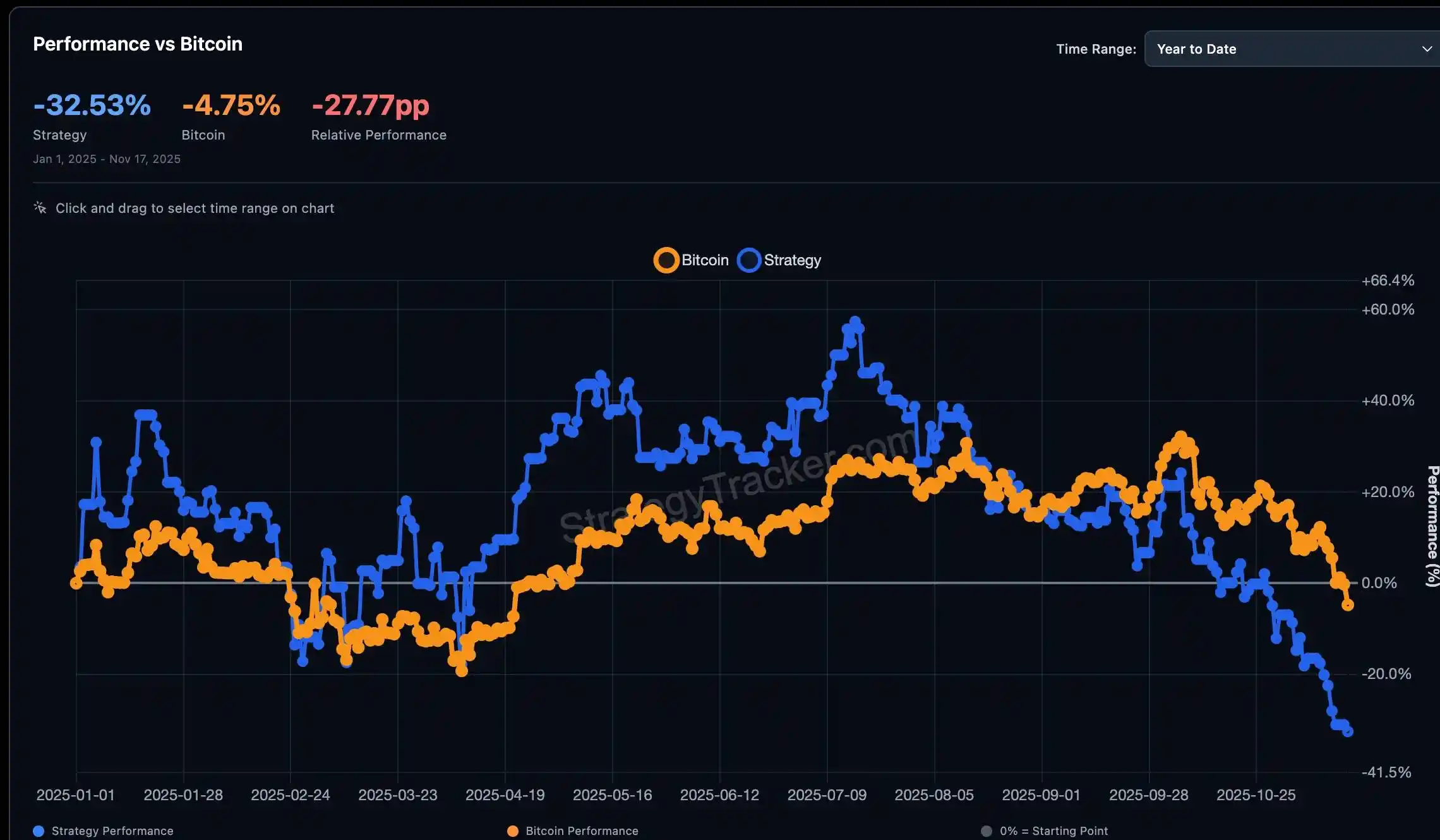
Considering the beginning of this year, BTC has only dropped by 4.75%, but MSTR's stock price has already fallen by 32.53%.
On November 17, MSTR's stock price hit a 52-week low of $194.54, falling for 6 consecutive days. From its all-time high this year, the stock price has dropped by 49.19%.
Compared to BTC, MSTR's stock has underperformed by 27 percentage points. The market is voting with its feet, suggesting that buying BTC directly may be a better option than buying MSTR.
Moreover, in the 2025 market, an increasing number of companies are adopting Bitcoin and other token reserve strategies, making MSTR no longer the only choice.
As more competitors emerge and the crypto market becomes more challenging, why should investors pay a premium for MSTR?
The logic behind MicroStrategy's entire model is actually quite clear: continuously fund BTC purchases, use BTC's value appreciation to support the stock price, and continue funding through stock price premiums.
However, when BTC experiences a significant drop, coupled with mNAV falling below 1, this cycle is no longer as smooth as before.
In November, Saylor continues to buy, but the ammunition is clearly insufficient.
Other DAT Companies Also Struggling
MSTR's plight is not unique.
The entire Digital Asset Treasury (DAT) sector has been suffering in November.
First, looking at companies holding BTC:

These companies follow a Bitcoin mining + treasury model. In the first two weeks of November, BTC dropped by about 15%, but their stock prices fell by over 30%.
But even more dismal are companies holding altcoins.
Companies holding ETH:

These companies hold ETH as their primary treasury asset. In the first two weeks of November, ETH's price dropped from $3,639 to $3,120 (-14.3%), but their stock prices plummeted by 17-20%.
Companies holding SOL:
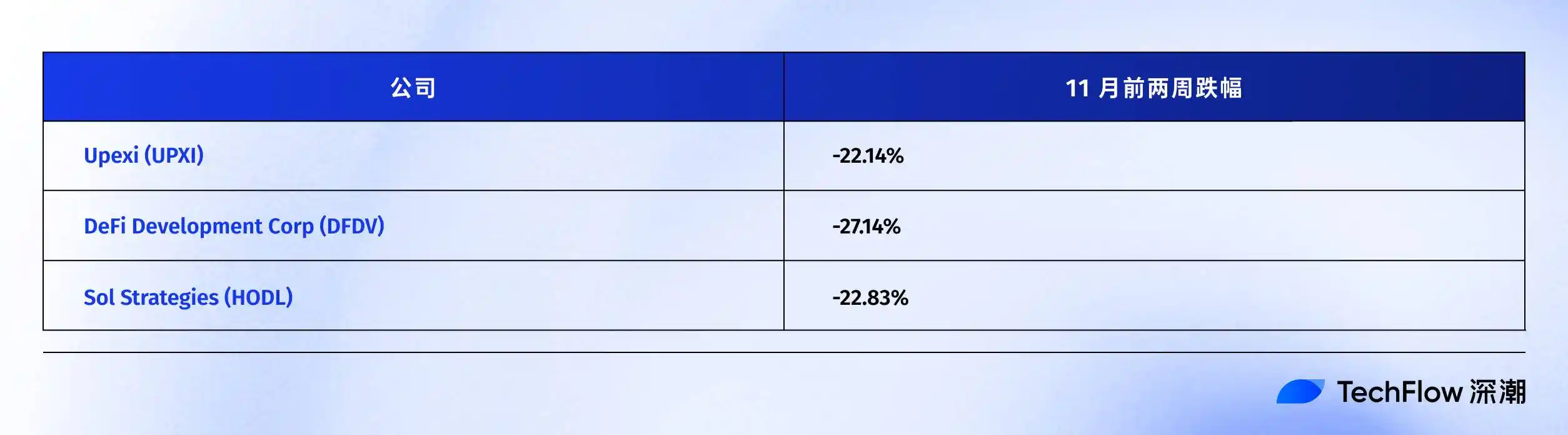
The most magical part here is DFDV, which skyrocketed by 24,506% in early 2025 due to the SOL treasury strategy. However, by November 17, it had dropped from a high of $187.99 to around $6.74.
Companies Holding BNB:

Why Did Shitcoin Treasury Companies Take a Harder Hit?
The logic is simple:
In this round of market pullback, BTC dropped by 25%, but shitcoins like ETH, SOL, BNB experienced a much larger drop than BTC.
When the treasury assets themselves are more volatile, the stock price will be further magnified. Moreover, shitcoin treasury companies also face a bigger issue: liquidity risk.
BTC is the most liquid crypto asset, so even holding hundreds of thousands of BTC, MSTR can slowly sell off through the OTC market or exchanges.
However, the liquidity of ETH, SOL, BNB is nowhere near that of BTC. When market fear strikes, the selling pressure of millions of ETH will further crush the price, creating a vicious cycle.
The big drop in November was a comprehensive stress test.
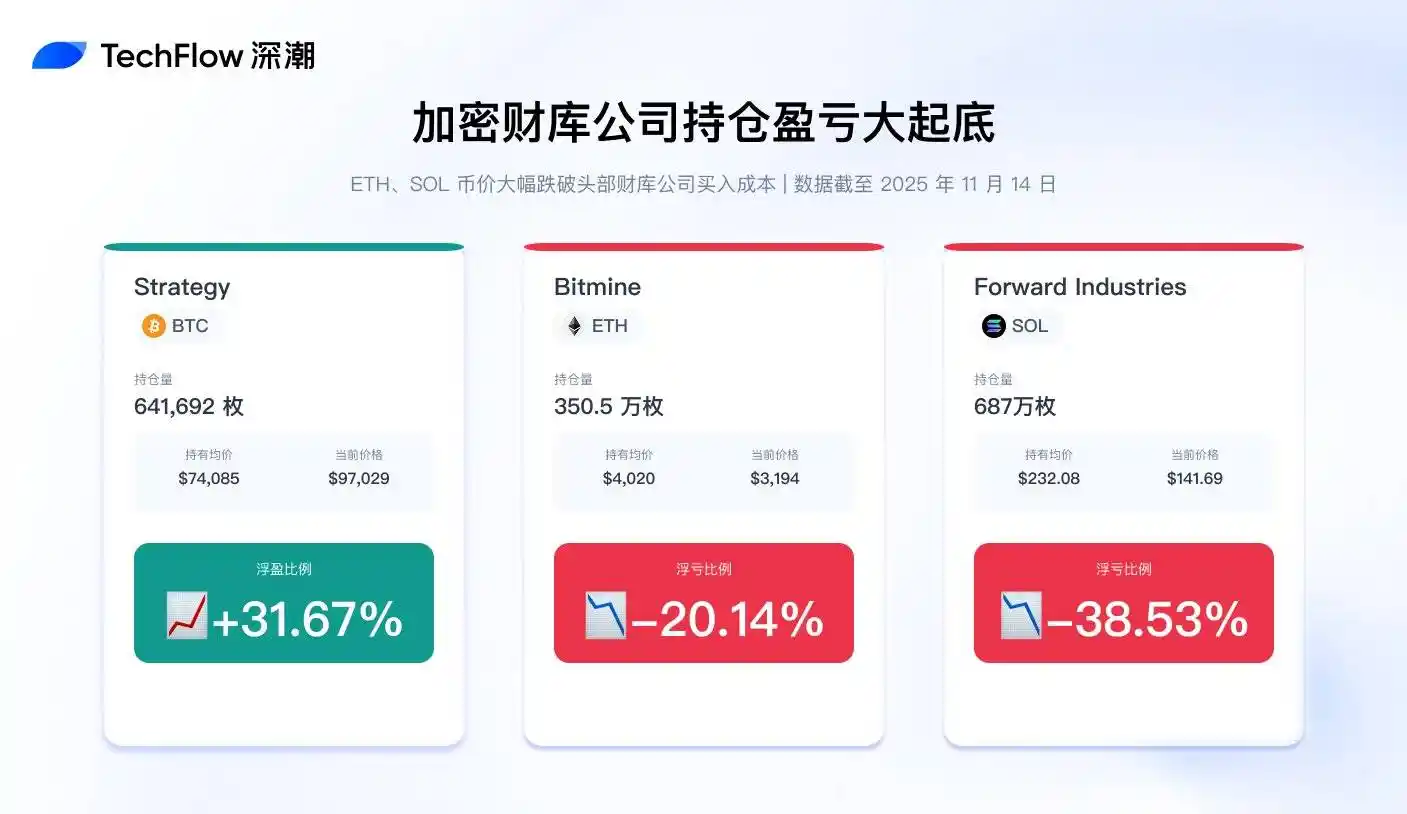
The results are clear—whether holding BTC or shitcoins, DAT company's stock price saw a much larger drop than its treasury assets.
And companies holding shitcoins face an even more severe impact.
When the Money Printer Breaks
Returning to the question at the beginning of the article: Even Saylor can't buy anymore, how about your DAT stocks?
The answer is already very clear.
In the November market, the last layer of shame for DAT stocks was torn off. According to the latest data from SaylorTracker, MSTR's Bitcoin holdings' market value has dropped below $60 billion, and its 649,870 bitcoins held are on the verge of dropping below $10 billion in unrealized gains.
When the mNAV drops below 1, MSTR's "BTC money printer" model gradually malfunctions. The path of issuing stocks to buy coins is no longer smooth, financing costs are soaring, ammunition is insufficient—these are the problems Saylor must face.
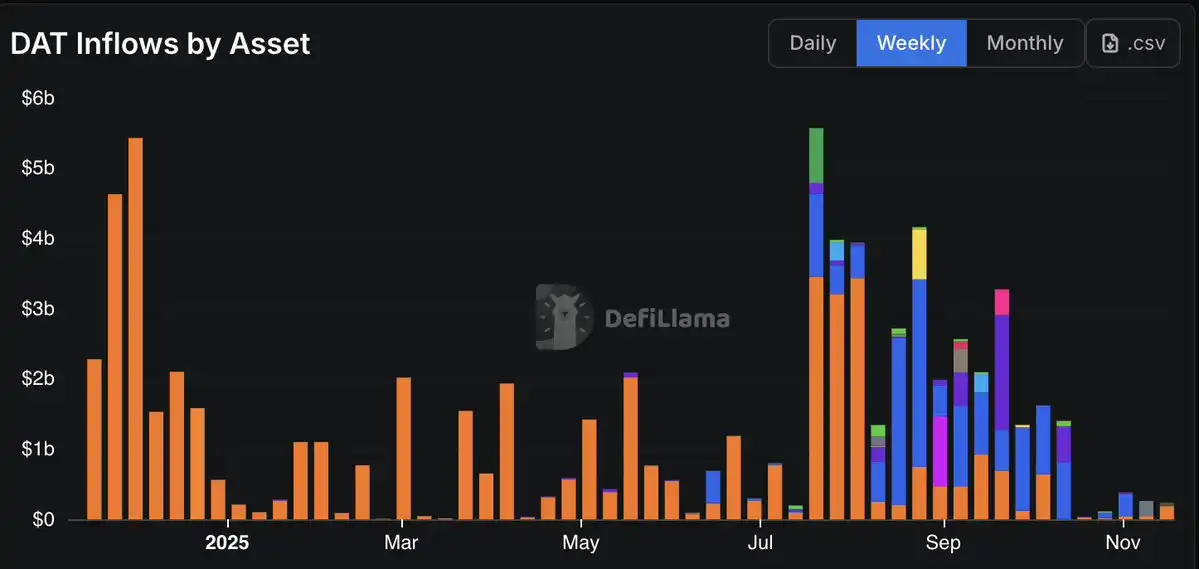
The data is also confirming this point, as the inflow of funds into DAT companies has shown a decreasing trend, with the October inflow hitting the lowest level since the 2024 election.
BTC mining stocks have generally dropped by 30%, ETH Treasury companies by 20%, and the stock prices of SOL and BNB Treasury companies have plummeted to the point of questioning life choices. Regardless of which company you are bullish on, the stock price decline far exceeds the treasury assets themselves.
While there is certainly an overall impact from the current stage of stock market investor sell-offs seeking safe havens, the inherent structural issue that the DAT model brings with it is becoming more challenging in this headwind scenario:
When the crypto market corrects, the leverage property of DAT stocks magnifies the decline. You thought you were buying "BTC exposure with a premium," but in reality, it's a leveraged downturn accelerator.
If you still hold these stocks, perhaps you should ask yourself:
Did you buy them for crypto exposure, or for that premium illusion that no longer exists?
You may also like

Bitcoin’s Historical Bottom Indicator Points to $62K – Could BTC Fall That Low?
Key Takeaways Bitcoin is nearing a critical support level of \$62,000, with key indicators suggesting potential further declines.…

Bitcoin Price Prediction: Binance Inflows Just Hit a 4-Year Low – Violent Move Above $100K is Next
Key Takeaways: Bitcoin inflows into Binance have dropped to their lowest in four years, potentially signaling a tight…

Russia Caps Crypto Investments at $4,000 Annually for Non-Qualified Investors – Will Others Follow Suit?
Key Takeaways Russia’s proposal sets a $4,000 annual investment limit for non-qualified crypto investors, sparking discussions on regulatory…

Japan’s Metaplanet Announces $137 Million Capital Raise Via Third-Party Allotment
Key Takeaways Japanese firm Metaplanet Inc. has strategized a $137 million capital raising through the third-party allotment of…

Crypto Price Prediction for January 28 – XRP, Solana, Bitcoin
Key Takeaways Bitcoin price recently hit $90,000 but struggled to maintain this peak. XRP and Solana are following…

Sygnum Bank Secures Over 750 BTC for Bitcoin Yield Fund’s Growth
Key Takeaways: Sygnum Bank has raised over 750 BTC in the initial phase of the Starboard Sygnum BTC…

Asia Market Open: Bitcoin Holds Steady Near $88K Amidst Asia’s Tech Slowdown and Gold Surge
Key Takeaways Bitcoin remains stable at nearly $88,000 as Asian tech markets show signs of cooling. Global markets…

Dogecoin Price Prediction: DOGE Founder Reveals True Cause of Crypto Market Downturn
Key Takeaways: The recent downturn in the cryptocurrency market, including Dogecoin, is attributed to shifting investor behavior rather…

US Senators Criticize DOJ Over Crypto Crime Unit Closure Amid Financial Conflict Concerns
Key Takeaways: Six US senators have criticized Deputy Attorney General Todd Blanche for shutting down the DOJ’s crypto…

Why Is Crypto Down Today? – January 29, 2026
Key Takeaways The crypto market has fallen by 1.7% over the past 24 hours, with significant declines in…

Bitcoin Retreats as Hawkish Fed and Outflows Pressure Market: Analyst
Key Takeaways: Bitcoin’s value dipped below the $89,000 mark due to restrictive financial conditions and growing geopolitical stress.…

Strive Retires Majority of Debt and Expands Bitcoin Holdings Following Preferred Stock Offering
Key Takeaways: Strive successfully retired 92% of debt inherited from acquiring Semler Scientific, amid a significant preferred stock…

Ethereum Price Prediction: Wall Street Firm Begins to Buy and Lock ETH – Is This Brave or Insane?
Key Takeaways BitMine’s significant investment in Ethereum by securing 4.2 million ETH and staking 2.2 million ETH showcases…

XRP Price Prediction: Price Looks Stagnant – But This Key Signal Just Flashed Green After Months
Key Takeaways Recent indicators suggest a potential bullish trend for XRP, indicating a possible price surge. Traders have…
Bitcoin Is Bouncing – But These 3 Metrics Decide If the Bull Market Is Returning
Key Takeaways Bitcoin’s recent climb towards the high-$90,000 and low-$80,000 ranges signals a partial recovery from significant sell-offs.…

Top Cryptocurrencies to Watch This January: XRP, Cardano, PEPE
Key Takeaways XRP seeks to capitalize on recent ETF approvals to potentially reach $5 in Q1. Cardano aims…
![[LIVE] Crypto News Today: Latest Updates for Jan. 23, 2026 – BTC Slides Below $90K as Crypto Market Extends Broad Sell-Off](https://weex-prod-cms.s3.ap-northeast-1.amazonaws.com/medium_21_2c30f7df62.png)
[LIVE] Crypto News Today: Latest Updates for Jan. 23, 2026 – BTC Slides Below $90K as Crypto Market Extends Broad Sell-Off
Key Takeaways The crypto market is in a downward trend, with GameFi, AI, and RWA sectors showing some…

XRP Price Prediction: $1.88 Triple-Bottom Support Amid ETF Money Pull Back – Analyzing Future Directions
Key Takeaways XRP currently stabilizes around $1.88 with triple-bottom support after recent price slips below $2.00. Institutional ETF…
Bitcoin’s Historical Bottom Indicator Points to $62K – Could BTC Fall That Low?
Key Takeaways Bitcoin is nearing a critical support level of \$62,000, with key indicators suggesting potential further declines.…
Bitcoin Price Prediction: Binance Inflows Just Hit a 4-Year Low – Violent Move Above $100K is Next
Key Takeaways: Bitcoin inflows into Binance have dropped to their lowest in four years, potentially signaling a tight…
Russia Caps Crypto Investments at $4,000 Annually for Non-Qualified Investors – Will Others Follow Suit?
Key Takeaways Russia’s proposal sets a $4,000 annual investment limit for non-qualified crypto investors, sparking discussions on regulatory…
Japan’s Metaplanet Announces $137 Million Capital Raise Via Third-Party Allotment
Key Takeaways Japanese firm Metaplanet Inc. has strategized a $137 million capital raising through the third-party allotment of…
Crypto Price Prediction for January 28 – XRP, Solana, Bitcoin
Key Takeaways Bitcoin price recently hit $90,000 but struggled to maintain this peak. XRP and Solana are following…
Sygnum Bank Secures Over 750 BTC for Bitcoin Yield Fund’s Growth
Key Takeaways: Sygnum Bank has raised over 750 BTC in the initial phase of the Starboard Sygnum BTC…


 App
App